Author: Arun Goswami

  • Revenue Leakage Between Marketing and Sales: 7 Gaps to Fix

    Revenue Leakage Between Marketing and Sales: 7 Gaps to Fix

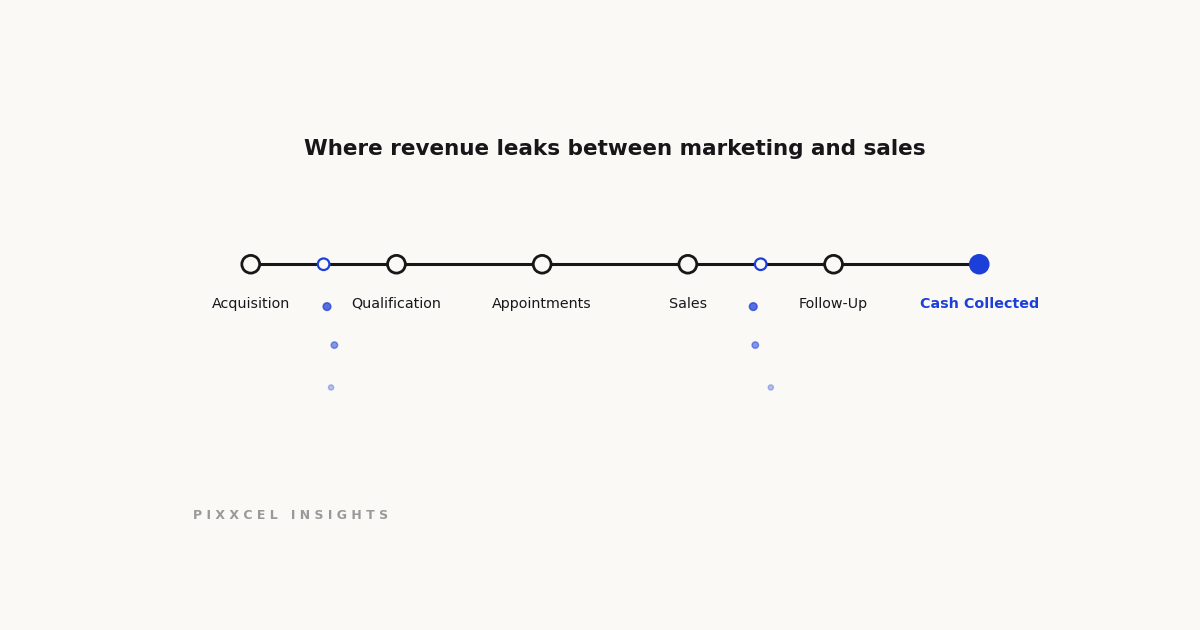
    High-ticket businesses rarely lose money because of one catastrophic failure. More often, revenue leaks out in small gaps between marketing and sales: a qualified lead waits too long for a callback, a booked call never happens, a promising prospect gets one follow-up and then disappears, or a closed deal takes weeks to turn into collected cash.

    That is why looking only at ad performance can be misleading. A campaign can generate leads at an acceptable cost while the business still struggles to convert demand into revenue.

    For founder-led businesses, coaches, EdTech companies, doctorpreneurs and professional education businesses, the real question is not simply, “Are the ads working?” It is, “Where between the click and the cash collected are we losing money?”

    What revenue leakage between marketing and sales actually means

    Revenue leakage is the value lost when a prospect enters your acquisition system but fails to progress because the next stage is slow, unclear, inconsistent or poorly measured.

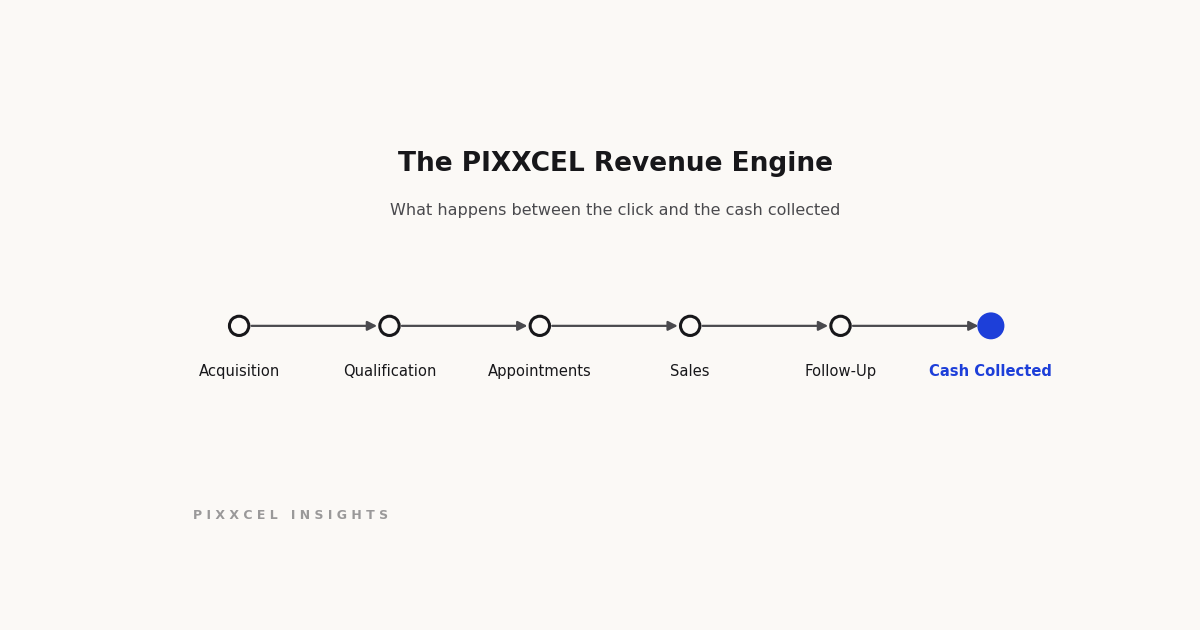
    The most useful way to diagnose it is to stop thinking of marketing and sales as separate departments. Treat them as one connected revenue engine:

    1. Acquisition
    2. Qualification
    3. Appointment booking
    4. Show-up
    5. Sales conversion
    6. Follow-up
    7. Cash collection

    A weak handoff at any one of these stages can make an otherwise healthy acquisition channel look unprofitable.

    1. The first leak: leads arrive, but nobody responds fast enough

    Many businesses spend aggressively to generate enquiries and then treat the lead as if the hard part is finished. It is not.

    A lead who has just filled a form, booked a consultation or responded to an offer is at a moment of unusually high intent. If the next interaction takes hours instead of minutes, the business is giving that intent time to cool down.

    Track these numbers separately:

    • time from enquiry to first contact attempt
    • percentage of leads contacted successfully
    • number of attempts made in the first 24 hours
    • percentage of contacted leads that reach the qualification stage

    If your acquisition numbers look healthy but your contact rate is weak, changing ad creative may not be the highest-priority fix.

    2. Qualification is either too loose or too aggressive

    High-ticket sales teams usually make one of two mistakes. They either book almost everybody, which fills calendars with low-intent calls, or they over-filter and reject people who could have become qualified opportunities with better nurturing.

    A useful qualification system should answer a small set of commercial questions before a salesperson invests substantial time. Depending on the business, that can include revenue maturity, offer price, current lead flow, buying intent, current marketing and sales setup, and investment capacity.

    The goal is not to create friction for the sake of it. The goal is to distinguish between:

    • someone who should speak with sales now
    • someone who needs nurturing first
    • someone who genuinely does not fit the offer

    This is one reason a strong revenue partner must understand more than media buying. If you are evaluating agencies, our guide on what business coaches should look for in a performance marketing agency explains why downstream economics matter as much as campaign metrics.

    3. Booked calls are treated as conversions when they are only intermediate outcomes

    A booked meeting can look excellent on a dashboard, but it has no commercial value if the prospect does not attend.

    Separate the following metrics:

    • qualified lead to booked call
    • booked call to show-up
    • show-up to proposal or next step
    • show-up to closed sale

    If you combine all of these into “cost per booked call,” you can miss the actual leak.

    For example, reducing the cost per booked call is not automatically useful if show-up quality deteriorates at the same time. The metric that matters is how efficiently qualified demand progresses toward collected revenue.

    4. Sales calls are happening, but the business cannot explain why prospects do not buy

    Once calls are happening consistently, the next question becomes diagnostic.

    Do not settle for “lead quality is bad” as the explanation for weak conversion. Break sales outcomes into reasons:

    • not enough urgency
    • offer mismatch
    • price objection
    • trust gap
    • decision-maker absent
    • timing issue
    • financing or payment issue
    • competitor selected
    • follow-up pending

    Patterns across these outcomes tell you whether the problem belongs to acquisition, qualification, positioning, the sales conversation, or follow-up.

    We covered this diagnosis in more depth in Why High Ticket Leads Don’t Convert: Fix First.

    5. Follow-up stops too early

    Many high-ticket businesses put enormous effort into generating the lead and conducting the sales conversation, then use weak follow-up for the prospects who do not buy immediately.

    That creates an expensive gap.

    A proper follow-up system should not be a sequence of “just checking in” messages. It should answer the prospect’s remaining questions, reinforce the business case, address objections, provide relevant proof and create a clear next action.

    Track:

    • open opportunities by age
    • follow-up attempts per opportunity
    • response rate by follow-up stage
    • revenue recovered from non-immediate buyers

    This is where CRM discipline matters. If opportunities live in individual WhatsApp chats, inboxes and salesperson memory, management has no reliable view of pipeline value.

    6. Closed revenue is confused with collected cash

    For high-ticket offers, a signed agreement or verbal commitment does not always mean the full amount has reached the bank.

    Payment plans, delayed transfers, failed mandates and pending invoices can create a large difference between:

    • revenue closed
    • revenue invoiced
    • cash actually collected

    If marketing decisions are being made using closed revenue while cash collection is materially lower, the business can overestimate the true return from acquisition.

    This is why PIXXCEL uses the idea of a Revenue Engine rather than looking at ads in isolation. The commercial system should connect acquisition all the way through to cash collected.

    7. The reporting system hides the leak

    A business cannot fix what it cannot locate.

    The minimum useful revenue dashboard should connect each stage rather than reporting them independently.

    Stage Question to answer
    Acquisition Are we generating the right enquiries?
    Qualification How many enquiries become genuine opportunities?
    Appointments How many qualified prospects book and attend?
    Sales How many attended calls progress or close?
    Follow-up How much pipeline is still recoverable?
    Collections How much closed revenue actually reached the bank?

    Once these stages are visible in one system, the team can stop making vague judgments and start fixing the specific constraint.

    How to find your biggest revenue leak this week

    You do not need to rebuild the entire funnel at once. Start with the last 30 days and calculate the conversion rate between every major stage.

    1. Count total enquiries.
    2. Count successfully contacted leads.
    3. Count qualified prospects.
    4. Count booked calls.
    5. Count attended calls.
    6. Count closed deals.
    7. Count cash collected.

    Then compare each transition.

    The stage with the largest unexplained drop is usually a better starting point than launching another campaign or rebuilding every landing page.

    The real goal: optimize the whole revenue engine

    Paid acquisition is important, but acquisition is only the first part of the commercial system.

    A business can generate more leads and still make less money if qualification deteriorates, sales capacity becomes overloaded, follow-up breaks or collections slow down.

    The stronger operating question is:

    What happens to each rupee of acquisition spend after the lead enters the system?

    That changes the conversation from “How do we get more leads?” to “How do we turn more of the demand we already generate into collected revenue?”

    Want to identify where your revenue engine is leaking?

    PIXXCEL works across acquisition, qualification, appointments, sales, follow-up and collections to identify what is happening between the click and the cash collected.

    Apply for the PIXXCEL Revenue Engine

    Frequently asked questions

    What is revenue leakage in marketing and sales?

    Revenue leakage is potential revenue lost because prospects fail to move efficiently from acquisition through qualification, appointments, sales, follow-up and cash collection.

    How do you identify revenue leakage?

    Measure conversion between each major stage of the revenue process. Look for the largest unexplained drop and investigate that stage before making broad changes elsewhere.

    Can good advertising still produce poor business results?

    Yes. Advertising can generate acceptable lead volume and cost metrics while the business loses value later through poor qualification, low show-up rates, weak sales conversion, inconsistent follow-up or slow collections.
  • Performance Marketing Agency for Business Coaches: What to Look For

    Performance Marketing Agency for Business Coaches: What to Look For

    For a high-ticket business coach, hiring a performance marketing agency is rarely just about getting more leads.

    The real question is whether the agency can help turn paid attention into qualified conversations, sales, and cash collected.

    That distinction matters because a campaign can look healthy inside an ad account while the business still struggles with poor lead quality, low show-up rates, weak sales conversion, slow follow-up, or inconsistent collections.

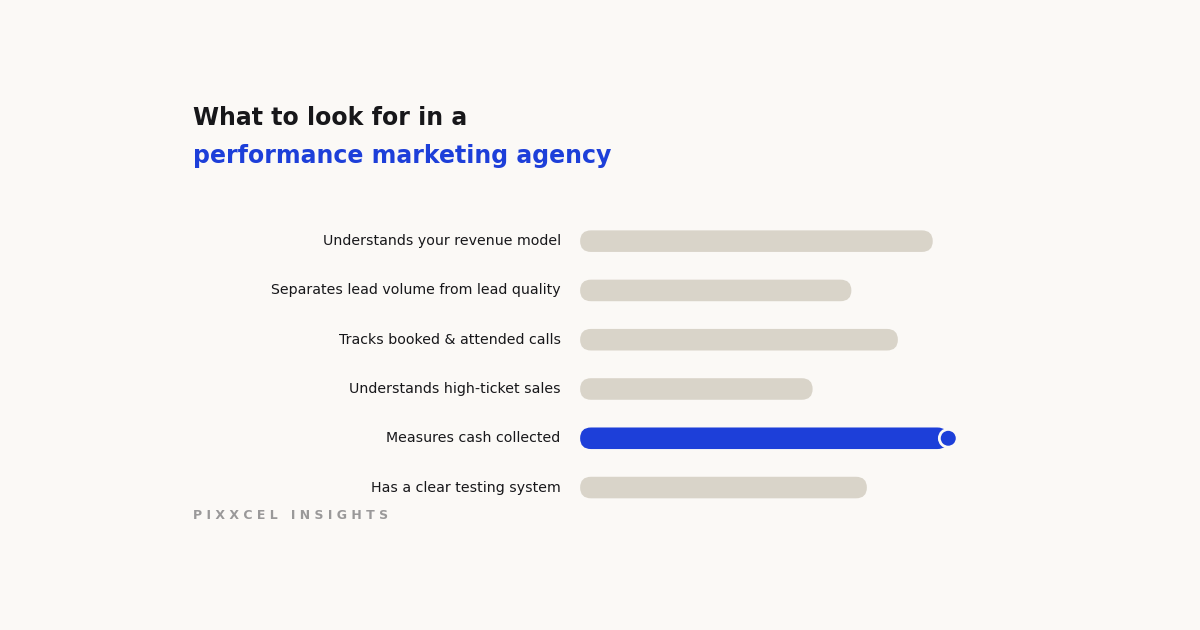
    If you are evaluating a performance marketing agency for your coaching business, here is what to look for before you sign.

    1. They should understand your revenue model, not just your ad account

    A strong agency should first understand how your business actually makes money.

    That includes your offer price, sales cycle, lead qualification process, booking flow, close rate, follow-up process, payment structure, and the amount of cash you collect from newly acquired customers.

    If the conversation starts and ends with CPM, CTR, CPL, and ROAS, the agency may be optimizing only one part of the system.

    For a high-ticket coaching business, the important path is broader:

    Acquisition → Qualification → Appointments → Sales → Follow-Up → Cash Collected

    An agency does not need to own every stage, but it should understand how each stage affects the economics of paid acquisition.

    2. They should separate lead volume from lead quality

    More leads are not automatically better.

    If your sales team spends time speaking to people who cannot afford the offer, are not decision-makers, are too early in their journey, or have no real intent to buy, a low cost per lead can become expensive very quickly.

    A useful agency should help define what a qualified lead actually means for your business.

    For example, qualification may include factors such as:

    • current business revenue
    • offer price
    • business maturity
    • current lead flow
    • existing marketing and sales setup
    • urgency of the problem
    • ability and willingness to invest

    The exact criteria will vary, but the principle is simple: paid media should be optimized around commercially useful demand, not just form fills.

    3. They should care about booked calls and attended calls

    For many coaching businesses, the lead is only the beginning.

    If your funnel depends on discovery calls, strategy calls, or application calls, then the agency should monitor what happens after the form submission.

    Key questions include:

    • How many leads complete the application?
    • How many book a call?
    • How many actually attend?
    • How many are qualified when they show up?
    • How many move into a real sales conversation?

    This is where a lot of apparent marketing problems are actually funnel or process problems.

    For example, an ad may attract the right person, but a slow response time, confusing booking page, weak reminder sequence, or poor pre-call nurturing can reduce the value of that lead before the sales team even speaks to them.

    4. They should understand high-ticket sales, even if they do not close for you

    High-ticket coaching is not an impulse purchase.

    Your prospect may need context, proof, trust, clarity, and several follow-ups before they make a decision.

    A performance marketing partner should understand how the ad promise connects to the sales conversation.

    If the ad attracts people with one expectation and the sales team presents a different promise, conversion will suffer.

    The agency should therefore be interested in:

    • the offer being sold
    • the language used in ads
    • the landing page promise
    • the application questions
    • the sales call structure
    • common objections
    • follow-up communication

    This does not mean the agency needs to run your sales team. It means they should understand that marketing and sales are one connected revenue system.

    5. They should measure cash collected, not just attributed revenue

    High-ticket businesses often sell through payment plans, deposits, financing, or delayed collections.

    That means the number shown as revenue inside a CRM may not be the same as the cash actually collected.

    When evaluating an agency, ask how they think about attribution.

    Do they stop at leads and booked calls? Do they track closed deals? Do they connect campaign data to actual collections where possible?

    The closer reporting gets to cash collected, the easier it becomes to make sensible scaling decisions.

    6. They should be able to diagnose the real bottleneck

    A common mistake is assuming every growth problem requires more ad spend.

    Sometimes the problem is acquisition. Sometimes it is qualification. Sometimes it is sales. Sometimes it is follow-up.

    A good partner should be able to say, with evidence, where the biggest leakage is happening.

    For example:

    • If click-through rates are weak, the creative or positioning may be the first issue.
    • If leads are cheap but unqualified, targeting, messaging, or qualification may need attention.
    • If qualified prospects are booking but not attending, reminders and pre-call nurturing may be the problem.
    • If good-fit prospects attend but rarely buy, the sales process deserves investigation.
    • If prospects show interest but disappear after the call, follow-up may be the biggest missed opportunity.

    The point is not to blame a department. The point is to find the constraint that is limiting revenue.

    7. They should have a clear testing system

    Performance marketing should not feel like random creative launches followed by vague reporting.

    You should be able to understand what is being tested and why.

    A sensible testing system may cover:

    • offers and hooks
    • creative angles
    • audience segments
    • landing page messaging
    • qualification questions
    • booking flow
    • follow-up sequences

    Each test should connect to a specific business problem or hypothesis.

    If the agency cannot explain what it is learning from your spend, it becomes difficult to distinguish optimization from activity.

    8. Their reporting should help you make decisions

    A founder should not need to decode a dashboard full of platform metrics every week.

    Good reporting should answer practical questions:

    • What changed?
    • Why did it change?
    • Where are we losing potential revenue?
    • What are we testing next?
    • What should we increase, reduce, fix, or stop?

    The purpose of reporting is not to prove that work happened. It is to improve the quality of the next decision.

    9. They should know when not to scale

    Increasing spend on a leaking funnel usually makes the leakage more expensive.

    Before scaling, the agency should have confidence that the business can handle additional demand.

    That means looking beyond the media account and asking whether qualification, appointment setting, sales capacity, follow-up, and collections can support higher volume.

    Sometimes the highest-value recommendation is not “spend more.” It is “fix this stage first, then scale.”

    10. Their incentives should match your growth objective

    Before choosing an agency, understand what they are actually accountable for.

    If their success is defined only as generating leads, they will naturally optimize toward lead generation.

    If your business needs profitable customer acquisition, the operating conversation should include deeper metrics.

    Ask what they review regularly, what they consider a successful month, and how they decide whether a campaign deserves more budget.

    A simple evaluation framework

    When speaking to a potential performance marketing agency, ask these questions:

    1. How will you define a qualified lead for our business?
    2. Which metrics do you track beyond cost per lead?
    3. How do you connect ads to booked calls, sales, and collections?
    4. How do you identify whether the bottleneck is marketing, qualification, sales, or follow-up?
    5. What does your testing process look like?
    6. How will our sales feedback influence advertising decisions?
    7. What needs to be true before you recommend scaling spend?

    The quality of the answers will tell you far more than a polished pitch deck.

    The better question is not “Can they run ads?”

    Most performance marketing agencies can launch campaigns.

    For a high-ticket coaching business, the more useful question is whether the agency understands the commercial system those campaigns feed into.

    PIXXCEL approaches this through the PIXXCEL Revenue Engine, with attention across acquisition, qualification, appointments, sales, follow-up, and cash collected.

    If your ads are generating activity but the revenue outcome still feels inconsistent, the first step is usually to identify where the leakage is happening.

    Apply for the PIXXCEL Revenue Engine to explore where your current funnel may be losing revenue between the click and the cash collected.

  • Why High Ticket Leads Don’t Convert: Fix First

    Why High Ticket Leads Don’t Convert: Fix First

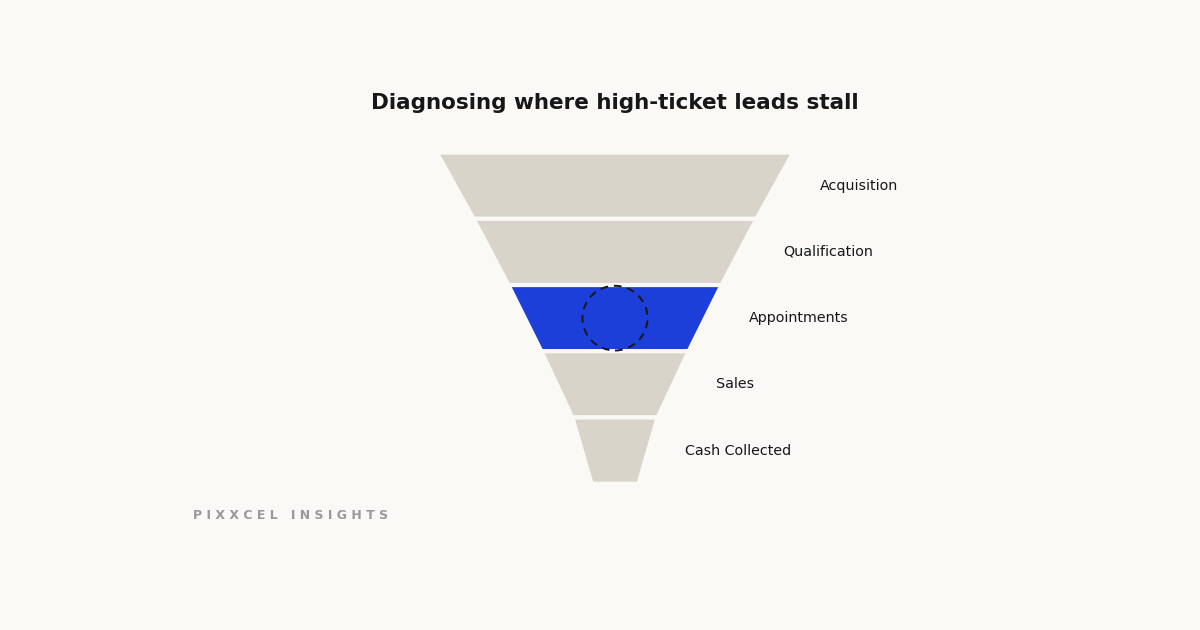
    Many founder-led businesses in coaching, EdTech, and high-ticket programs experience the same frustrating pattern: ad spend generates leads, but those leads rarely become paying clients. The sales pipeline looks full, yet cash collected lags far behind projections. You may see booked calls drop off, or prospects vanish after a promising conversation. The problem is not just lead generation, but what happens between the click and the cash.

    Understanding where your high-ticket leads fall out of the process is the first step to fixing your revenue engine. Without a structured diagnosis, you risk wasting resources on the wrong fixes, like tweaking ad creative when the real issue is follow-up or payment collection. This article gives you a founder-level framework to audit every stage between acquisition and cash, so you can identify and address the true bottlenecks holding back your growth.

    Diagnosing Acquisition Fit for High-Ticket Leads

    Start by asking: are you attracting the right leads for your high-ticket offer? Not every click is created equal. If your lead sources or targeting are misaligned with your ideal customer profile, you will see poor conversion rates no matter how good your sales process is.

    • Symptom: High lead volume but low qualification or sales rates.
    • Data to Inspect: Group leads by acquisition channel and offer. Build a cohort from a specific date range, tracking each lead from first click through to cash collected. Compare the promise in your ads and landing pages with the actual sales call pitch and price point. Review disqualification reasons, not just click-through rates.
    • Plausible Cause: The message or targeting in your ads attracts people outside your true buyer persona, or the offer is unclear or mismatched to the audience.
    • Actionable Test: Audit your ad and landing page messaging against your sales script and pricing. Interview recent leads who did not qualify or buy to understand what attracted them and where expectations diverged. Adjust your targeting or creative only after confirming a misalignment.

    Assessing Lead Qualification and Contactability

    Even if you are generating leads from the right audience, your qualification process may be too loose or too slow. Many founder-led teams treat every lead as equal, but high-ticket sales require a sharper filter based on need, fit, ability to invest, and buying timeframe.

    • Symptom: Many leads are unreachable, unresponsive, or not a fit for your program.
    • Data to Inspect: For each lead, track creation time, first contact attempt, owner, valid contact details, consent or preferred channel, and outcome. Separate unreachable leads from those who are unsuitable. Review your qualification criteria and scoring system.
    • Plausible Cause: Leads are not being qualified on key criteria, or contact attempts are delayed or inconsistent. Some leads may never be reached due to missing or invalid contact info.
    • Actionable Test: Define qualification based on explicit need, program fit, investment ability, and buying window. Set an operational response time target based on your team’s capacity. Audit a recent batch of leads for contact attempt timing and outcome, and refine your qualification process to prioritize quality over quantity.

    Improving Appointment Booking and Show-Up Rates

    Booking calls is not the same as having real sales conversations. Many high-ticket businesses see a sharp drop between qualified leads and attended appointments. This is often a sign that prospects do not perceive enough value in showing up, or that your booking process is confusing or inconvenient.

    • Symptom: Qualified leads book calls but do not attend, or never book at all.
    • Data to Inspect: Track the number of qualified leads, booked calls, and attended calls. Separate never-booked leads from booked no-shows. Check available time slots, timezone handling, confirmation messages, agenda clarity, and rescheduling options.
    • Plausible Cause: The booking process is unclear, inconvenient, or does not reinforce the value of attending. Confirmation and reminders may be weak or missing.
    • Actionable Test: Review your booking flow as if you were a prospect. Ensure time slots are accessible, confirmations are immediate, and reminders are sent via the prospect’s preferred channel. Add a pre-call agenda or value statement to reinforce why attending matters.

    Enhancing Offer and Sales Conversion Tactics

    Once a qualified lead attends a call, the focus shifts to converting that opportunity into a buyer. If you see a pattern of attended calls with few sales, the issue is rarely just lead quality. Instead, look for mismatched expectations, unclear deliverables, or ineffective objection handling.

    • Symptom: Many attended qualified calls, but few buyers.
    • Data to Inspect: Review call recordings or notes by objection type, closer, and outcome. Track which objections are most common and whether they relate to price, fit, timing, or trust. Compare the sales conversation to the original promise made in ads and landing pages.
    • Plausible Cause: The offer is not clearly articulated, or the sales process fails to address key objections. There may be a disconnect between what was promised and what is delivered.
    • Actionable Test: Map objections and lost deals to specific points in your sales script. Revise your pitch to clarify deliverables and outcomes. Train your team to handle the most common objections with proof and empathy, not pressure.

    Strengthening Follow-Up Strategies

    Follow-up is the bridge between interest and decision. Many founder-led teams neglect systematic follow-up, assuming that if a prospect does not buy on the call, the opportunity is lost. In reality, high-ticket sales often require multiple touches and ongoing engagement.

    • Symptom: Open opportunities stall, or prospects disappear after a promising call.
    • Data to Inspect: For every open opportunity, log the reason for the current status, next action, owner, and next-action date. Distinguish between follow-up before a decision and payment follow-up after agreement. Track opt-outs and respect them.
    • Plausible Cause: Lack of structured follow-up, unclear next steps, or no assigned owner for each opportunity.
    • Actionable Test: Implement a follow-up protocol where every open deal has a clear next action, owner, and scheduled date. Use a CRM or simple tracker to ensure no opportunity falls through the cracks. Personalize follow-up based on the last interaction and prospect’s stated concerns.

    Optimizing Payment Collection Processes

    Closing a deal does not guarantee cash in the bank. Payment collection is often overlooked, especially in high-ticket programs with instalments or delayed payments. Tracking only booked revenue, not actual cash collected, leads to inflated forecasts and cash flow surprises.

    • Symptom: Signed agreements or verbal commitments do not translate into received payments.
    • Data to Inspect: Track cash actually received, refunds issued, and outstanding scheduled instalments for each cohort of leads. Separate cash collected from contract value. Monitor payment timelines and follow-up on overdue instalments.
    • Plausible Cause: Weak payment follow-up, unclear payment instructions, or lack of tracking for scheduled payments and refunds.
    • Actionable Test: Set up a payment tracking system that logs every payment received, scheduled, or overdue. Assign responsibility for payment follow-up and communicate clear payment instructions at the point of sale. Regularly reconcile cash collected against booked deals to spot gaps early.

    Compact Diagnosis Table

    Stage Symptom Key Data Action
    Acquisition Fit High leads, low qualification Lead source, offer alignment, disqualification reasons Audit messaging and targeting
    Qualification Unreachable or unfit leads Contact attempts, qualification criteria Refine qualification and response time
    Appointments Low bookings or no-shows Booked vs. attended calls, confirmation process Improve booking flow and reminders
    Sales Conversion Attended calls, few buyers Objection types, call outcomes Clarify offer, objection handling
    Follow-Up Stalled deals Next action, owner, follow-up log Systematize follow-up
    Payment Collection Deals not paid Cash received, refunds, instalments Track and follow up payments

    Checklist: Five-Day Revenue Engine Audit

    1. Day 1: Build a cohort from leads acquired in a defined date range. Group by offer and source, and map each lead’s journey from click to cash.
    2. Day 2: Audit your ad and landing page promise against your sales call pitch and price. Interview recent leads who did not qualify or buy.
    3. Day 3: Review qualification and contactability. For each lead, check contact attempt timing, owner, and outcome. Separate unreachable from unfit leads.
    4. Day 4: Analyze appointment booking and show-up rates. Walk through your booking process as a prospect. Check reminders, confirmation, and agenda clarity.
    5. Day 5: Track open opportunities and payment collection. Ensure every deal has a next action, owner, and payment status. Reconcile cash collected with booked deals.

    Understanding Metrics and Bottlenecks

    To prioritize fixes, look for the stage where you lose the most qualified demand, not just the lowest conversion percentage. For example, if you have many qualified leads but few bookings, focus on your booking process. If most deals stall after the call, strengthen follow-up and payment collection. Always compare metrics within the same cohort and conversion window, not by dividing unrelated periods.

    Here are the key metrics to track at each stage:

    • Qualification Rate: Qualified leads divided by contacted leads.
    • Booking Rate: Booked calls divided by qualified leads.
    • Show-Up Rate: Attended calls divided by booked calls.
    • Close Rate: Buyers divided by attended qualified calls.
    • Cash Collected ROAS: Cash received divided by ad spend for the same cohort, before refunds and other costs.

    Imagine a scenario where you generate a batch of leads, contact them, qualify a subset, book calls, and close a few deals. If you see a noticeable gap between qualified leads and booked calls, your booking process is likely the issue. If most calls are attended but few deals close, focus on your sales conversation and offer clarity. If deals are closed but cash is not collected, payment tracking and follow-up need attention.

    PIXXCEL Revenue Engine: A Structured Approach

    The PIXXCEL Revenue Engine framework covers every stage from acquisition to cash collected: Acquisition, Qualification, Appointments, Sales, Follow-up, and Cash Collected. By diagnosing each stage with concrete data and targeted actions, you can systematically remove bottlenecks and turn more leads into revenue. This approach is especially critical for coaches, EdTech founders, and high-ticket program owners who cannot afford to let qualified demand slip through the cracks.

    If you are ready to fix what happens between the click and the cash, and want a proven system to diagnose and optimize every stage, Apply for PIXXCEL Revenue Engine.

  • Welcome to PIXXCEL Insights

    Welcome to PIXXCEL Insights

    PIXXCEL Insights is where we publish the playbooks, benchmarks, and revenue-growth research behind our client work at PIXXCEL. Expect practical breakdowns of paid acquisition, funnels, and follow-up systems for high-ticket businesses, drawn from real campaigns we run for clients like Dr. Qamar Mulla, Cranes Varsity, and Doctorpreneur Academy.