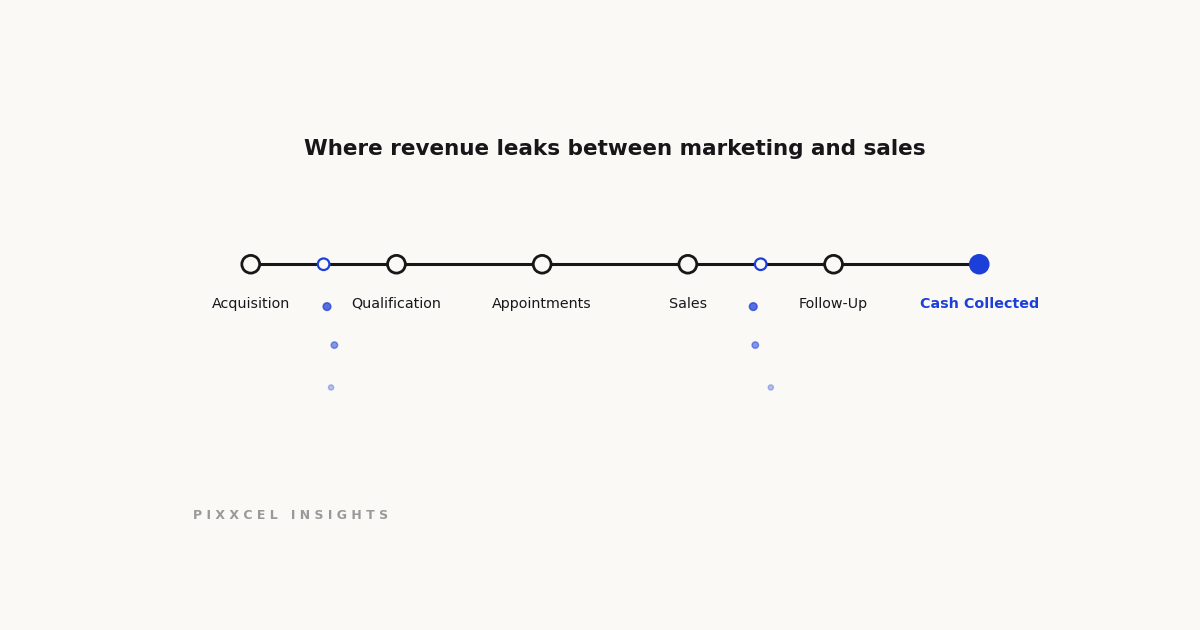
High-ticket businesses rarely lose money because of one catastrophic failure. More often, revenue leaks out in small gaps between marketing and sales: a qualified lead waits too long for a callback, a booked call never happens, a promising prospect gets one follow-up and then disappears, or a closed deal takes weeks to turn into collected cash.
That is why looking only at ad performance can be misleading. A campaign can generate leads at an acceptable cost while the business still struggles to convert demand into revenue.
For founder-led businesses, coaches, EdTech companies, doctorpreneurs and professional education businesses, the real question is not simply, “Are the ads working?” It is, “Where between the click and the cash collected are we losing money?”
What revenue leakage between marketing and sales actually means
Revenue leakage is the value lost when a prospect enters your acquisition system but fails to progress because the next stage is slow, unclear, inconsistent or poorly measured.
The most useful way to diagnose it is to stop thinking of marketing and sales as separate departments. Treat them as one connected revenue engine:
- Acquisition
- Qualification
- Appointment booking
- Show-up
- Sales conversion
- Follow-up
- Cash collection
A weak handoff at any one of these stages can make an otherwise healthy acquisition channel look unprofitable.
1. The first leak: leads arrive, but nobody responds fast enough
Many businesses spend aggressively to generate enquiries and then treat the lead as if the hard part is finished. It is not.
A lead who has just filled a form, booked a consultation or responded to an offer is at a moment of unusually high intent. If the next interaction takes hours instead of minutes, the business is giving that intent time to cool down.
Track these numbers separately:
- time from enquiry to first contact attempt
- percentage of leads contacted successfully
- number of attempts made in the first 24 hours
- percentage of contacted leads that reach the qualification stage
If your acquisition numbers look healthy but your contact rate is weak, changing ad creative may not be the highest-priority fix.
2. Qualification is either too loose or too aggressive
High-ticket sales teams usually make one of two mistakes. They either book almost everybody, which fills calendars with low-intent calls, or they over-filter and reject people who could have become qualified opportunities with better nurturing.
A useful qualification system should answer a small set of commercial questions before a salesperson invests substantial time. Depending on the business, that can include revenue maturity, offer price, current lead flow, buying intent, current marketing and sales setup, and investment capacity.
The goal is not to create friction for the sake of it. The goal is to distinguish between:
- someone who should speak with sales now
- someone who needs nurturing first
- someone who genuinely does not fit the offer
This is one reason a strong revenue partner must understand more than media buying. If you are evaluating agencies, our guide on what business coaches should look for in a performance marketing agency explains why downstream economics matter as much as campaign metrics.
3. Booked calls are treated as conversions when they are only intermediate outcomes
A booked meeting can look excellent on a dashboard, but it has no commercial value if the prospect does not attend.
Separate the following metrics:
- qualified lead to booked call
- booked call to show-up
- show-up to proposal or next step
- show-up to closed sale
If you combine all of these into “cost per booked call,” you can miss the actual leak.
For example, reducing the cost per booked call is not automatically useful if show-up quality deteriorates at the same time. The metric that matters is how efficiently qualified demand progresses toward collected revenue.
4. Sales calls are happening, but the business cannot explain why prospects do not buy
Once calls are happening consistently, the next question becomes diagnostic.
Do not settle for “lead quality is bad” as the explanation for weak conversion. Break sales outcomes into reasons:
- not enough urgency
- offer mismatch
- price objection
- trust gap
- decision-maker absent
- timing issue
- financing or payment issue
- competitor selected
- follow-up pending
Patterns across these outcomes tell you whether the problem belongs to acquisition, qualification, positioning, the sales conversation, or follow-up.
We covered this diagnosis in more depth in Why High Ticket Leads Don’t Convert: Fix First.
5. Follow-up stops too early
Many high-ticket businesses put enormous effort into generating the lead and conducting the sales conversation, then use weak follow-up for the prospects who do not buy immediately.
That creates an expensive gap.
A proper follow-up system should not be a sequence of “just checking in” messages. It should answer the prospect’s remaining questions, reinforce the business case, address objections, provide relevant proof and create a clear next action.
Track:
- open opportunities by age
- follow-up attempts per opportunity
- response rate by follow-up stage
- revenue recovered from non-immediate buyers
This is where CRM discipline matters. If opportunities live in individual WhatsApp chats, inboxes and salesperson memory, management has no reliable view of pipeline value.
6. Closed revenue is confused with collected cash
For high-ticket offers, a signed agreement or verbal commitment does not always mean the full amount has reached the bank.
Payment plans, delayed transfers, failed mandates and pending invoices can create a large difference between:
- revenue closed
- revenue invoiced
- cash actually collected
If marketing decisions are being made using closed revenue while cash collection is materially lower, the business can overestimate the true return from acquisition.
This is why PIXXCEL uses the idea of a Revenue Engine rather than looking at ads in isolation. The commercial system should connect acquisition all the way through to cash collected.
7. The reporting system hides the leak
A business cannot fix what it cannot locate.
The minimum useful revenue dashboard should connect each stage rather than reporting them independently.
| Stage | Question to answer |
|---|---|
| Acquisition | Are we generating the right enquiries? |
| Qualification | How many enquiries become genuine opportunities? |
| Appointments | How many qualified prospects book and attend? |
| Sales | How many attended calls progress or close? |
| Follow-up | How much pipeline is still recoverable? |
| Collections | How much closed revenue actually reached the bank? |
Once these stages are visible in one system, the team can stop making vague judgments and start fixing the specific constraint.
How to find your biggest revenue leak this week
You do not need to rebuild the entire funnel at once. Start with the last 30 days and calculate the conversion rate between every major stage.
- Count total enquiries.
- Count successfully contacted leads.
- Count qualified prospects.
- Count booked calls.
- Count attended calls.
- Count closed deals.
- Count cash collected.
Then compare each transition.
The stage with the largest unexplained drop is usually a better starting point than launching another campaign or rebuilding every landing page.
The real goal: optimize the whole revenue engine
Paid acquisition is important, but acquisition is only the first part of the commercial system.
A business can generate more leads and still make less money if qualification deteriorates, sales capacity becomes overloaded, follow-up breaks or collections slow down.
The stronger operating question is:
What happens to each rupee of acquisition spend after the lead enters the system?
That changes the conversation from “How do we get more leads?” to “How do we turn more of the demand we already generate into collected revenue?”
Want to identify where your revenue engine is leaking?
PIXXCEL works across acquisition, qualification, appointments, sales, follow-up and collections to identify what is happening between the click and the cash collected.
Frequently asked questions
What is revenue leakage in marketing and sales?
Revenue leakage is potential revenue lost because prospects fail to move efficiently from acquisition through qualification, appointments, sales, follow-up and cash collection.
How do you identify revenue leakage?
Measure conversion between each major stage of the revenue process. Look for the largest unexplained drop and investigate that stage before making broad changes elsewhere.
Can good advertising still produce poor business results?
Yes. Advertising can generate acceptable lead volume and cost metrics while the business loses value later through poor qualification, low show-up rates, weak sales conversion, inconsistent follow-up or slow collections.
Leave a Reply