For a high-ticket business coach, hiring a performance marketing agency is rarely just about getting more leads.
The real question is whether the agency can help turn paid attention into qualified conversations, sales, and cash collected.
That distinction matters because a campaign can look healthy inside an ad account while the business still struggles with poor lead quality, low show-up rates, weak sales conversion, slow follow-up, or inconsistent collections.
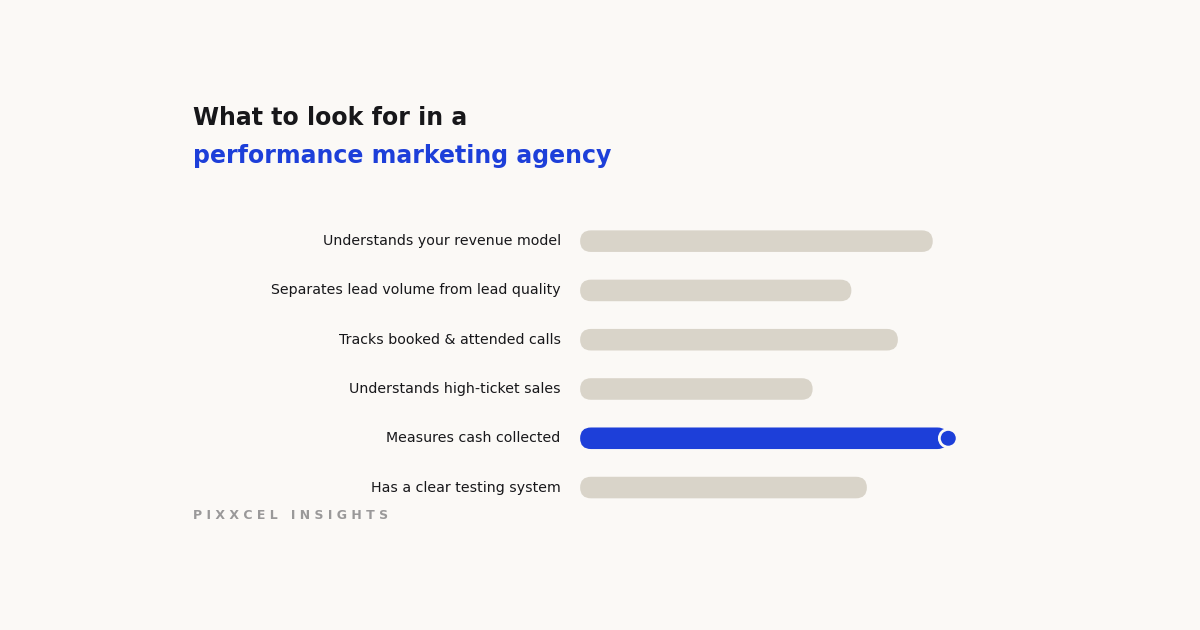
If you are evaluating a performance marketing agency for your coaching business, here is what to look for before you sign.
1. They should understand your revenue model, not just your ad account
A strong agency should first understand how your business actually makes money.
That includes your offer price, sales cycle, lead qualification process, booking flow, close rate, follow-up process, payment structure, and the amount of cash you collect from newly acquired customers.
If the conversation starts and ends with CPM, CTR, CPL, and ROAS, the agency may be optimizing only one part of the system.
For a high-ticket coaching business, the important path is broader:
Acquisition → Qualification → Appointments → Sales → Follow-Up → Cash Collected
An agency does not need to own every stage, but it should understand how each stage affects the economics of paid acquisition.
2. They should separate lead volume from lead quality
More leads are not automatically better.
If your sales team spends time speaking to people who cannot afford the offer, are not decision-makers, are too early in their journey, or have no real intent to buy, a low cost per lead can become expensive very quickly.
A useful agency should help define what a qualified lead actually means for your business.
For example, qualification may include factors such as:
- current business revenue
- offer price
- business maturity
- current lead flow
- existing marketing and sales setup
- urgency of the problem
- ability and willingness to invest
The exact criteria will vary, but the principle is simple: paid media should be optimized around commercially useful demand, not just form fills.
3. They should care about booked calls and attended calls
For many coaching businesses, the lead is only the beginning.
If your funnel depends on discovery calls, strategy calls, or application calls, then the agency should monitor what happens after the form submission.
Key questions include:
- How many leads complete the application?
- How many book a call?
- How many actually attend?
- How many are qualified when they show up?
- How many move into a real sales conversation?
This is where a lot of apparent marketing problems are actually funnel or process problems.
For example, an ad may attract the right person, but a slow response time, confusing booking page, weak reminder sequence, or poor pre-call nurturing can reduce the value of that lead before the sales team even speaks to them.
4. They should understand high-ticket sales, even if they do not close for you
High-ticket coaching is not an impulse purchase.
Your prospect may need context, proof, trust, clarity, and several follow-ups before they make a decision.
A performance marketing partner should understand how the ad promise connects to the sales conversation.
If the ad attracts people with one expectation and the sales team presents a different promise, conversion will suffer.
The agency should therefore be interested in:
- the offer being sold
- the language used in ads
- the landing page promise
- the application questions
- the sales call structure
- common objections
- follow-up communication
This does not mean the agency needs to run your sales team. It means they should understand that marketing and sales are one connected revenue system.
5. They should measure cash collected, not just attributed revenue
High-ticket businesses often sell through payment plans, deposits, financing, or delayed collections.
That means the number shown as revenue inside a CRM may not be the same as the cash actually collected.
When evaluating an agency, ask how they think about attribution.
Do they stop at leads and booked calls? Do they track closed deals? Do they connect campaign data to actual collections where possible?
The closer reporting gets to cash collected, the easier it becomes to make sensible scaling decisions.
6. They should be able to diagnose the real bottleneck
A common mistake is assuming every growth problem requires more ad spend.
Sometimes the problem is acquisition. Sometimes it is qualification. Sometimes it is sales. Sometimes it is follow-up.
A good partner should be able to say, with evidence, where the biggest leakage is happening.
For example:
- If click-through rates are weak, the creative or positioning may be the first issue.
- If leads are cheap but unqualified, targeting, messaging, or qualification may need attention.
- If qualified prospects are booking but not attending, reminders and pre-call nurturing may be the problem.
- If good-fit prospects attend but rarely buy, the sales process deserves investigation.
- If prospects show interest but disappear after the call, follow-up may be the biggest missed opportunity.
The point is not to blame a department. The point is to find the constraint that is limiting revenue.
7. They should have a clear testing system
Performance marketing should not feel like random creative launches followed by vague reporting.
You should be able to understand what is being tested and why.
A sensible testing system may cover:
- offers and hooks
- creative angles
- audience segments
- landing page messaging
- qualification questions
- booking flow
- follow-up sequences
Each test should connect to a specific business problem or hypothesis.
If the agency cannot explain what it is learning from your spend, it becomes difficult to distinguish optimization from activity.
8. Their reporting should help you make decisions
A founder should not need to decode a dashboard full of platform metrics every week.
Good reporting should answer practical questions:
- What changed?
- Why did it change?
- Where are we losing potential revenue?
- What are we testing next?
- What should we increase, reduce, fix, or stop?
The purpose of reporting is not to prove that work happened. It is to improve the quality of the next decision.
9. They should know when not to scale
Increasing spend on a leaking funnel usually makes the leakage more expensive.
Before scaling, the agency should have confidence that the business can handle additional demand.
That means looking beyond the media account and asking whether qualification, appointment setting, sales capacity, follow-up, and collections can support higher volume.
Sometimes the highest-value recommendation is not “spend more.” It is “fix this stage first, then scale.”
10. Their incentives should match your growth objective
Before choosing an agency, understand what they are actually accountable for.
If their success is defined only as generating leads, they will naturally optimize toward lead generation.
If your business needs profitable customer acquisition, the operating conversation should include deeper metrics.
Ask what they review regularly, what they consider a successful month, and how they decide whether a campaign deserves more budget.
A simple evaluation framework
When speaking to a potential performance marketing agency, ask these questions:
- How will you define a qualified lead for our business?
- Which metrics do you track beyond cost per lead?
- How do you connect ads to booked calls, sales, and collections?
- How do you identify whether the bottleneck is marketing, qualification, sales, or follow-up?
- What does your testing process look like?
- How will our sales feedback influence advertising decisions?
- What needs to be true before you recommend scaling spend?
The quality of the answers will tell you far more than a polished pitch deck.
The better question is not “Can they run ads?”
Most performance marketing agencies can launch campaigns.
For a high-ticket coaching business, the more useful question is whether the agency understands the commercial system those campaigns feed into.
PIXXCEL approaches this through the PIXXCEL Revenue Engine, with attention across acquisition, qualification, appointments, sales, follow-up, and cash collected.
If your ads are generating activity but the revenue outcome still feels inconsistent, the first step is usually to identify where the leakage is happening.
Apply for the PIXXCEL Revenue Engine to explore where your current funnel may be losing revenue between the click and the cash collected.
Leave a Reply