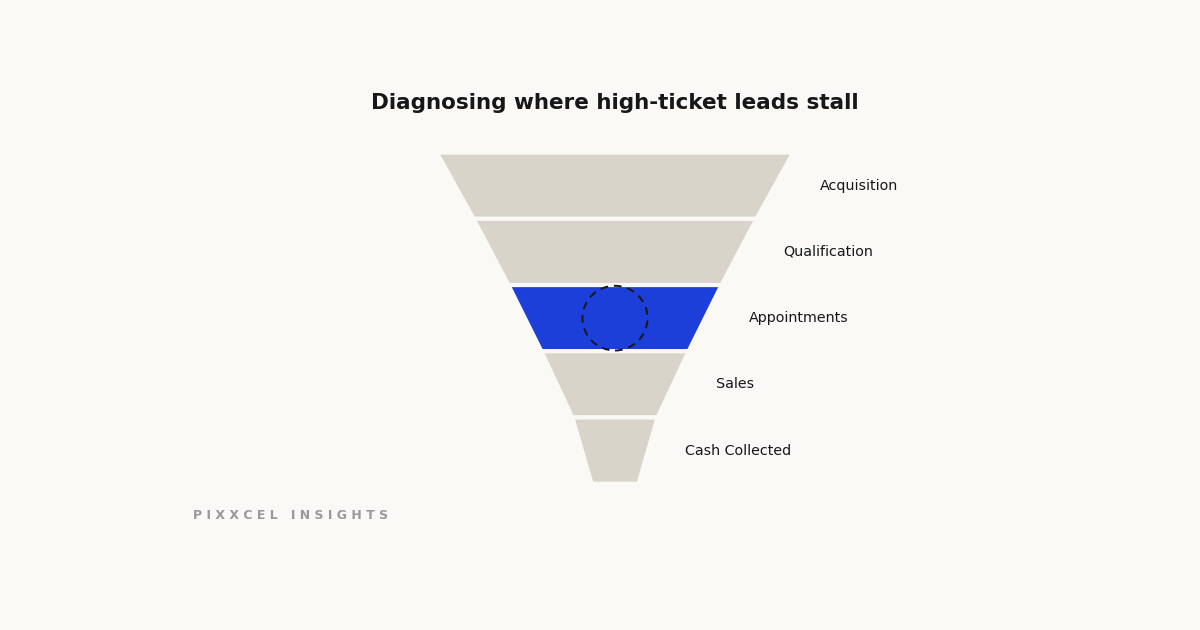
Many founder-led businesses in coaching, EdTech, and high-ticket programs experience the same frustrating pattern: ad spend generates leads, but those leads rarely become paying clients. The sales pipeline looks full, yet cash collected lags far behind projections. You may see booked calls drop off, or prospects vanish after a promising conversation. The problem is not just lead generation, but what happens between the click and the cash.
Understanding where your high-ticket leads fall out of the process is the first step to fixing your revenue engine. Without a structured diagnosis, you risk wasting resources on the wrong fixes, like tweaking ad creative when the real issue is follow-up or payment collection. This article gives you a founder-level framework to audit every stage between acquisition and cash, so you can identify and address the true bottlenecks holding back your growth.
Diagnosing Acquisition Fit for High-Ticket Leads
Start by asking: are you attracting the right leads for your high-ticket offer? Not every click is created equal. If your lead sources or targeting are misaligned with your ideal customer profile, you will see poor conversion rates no matter how good your sales process is.
- Symptom: High lead volume but low qualification or sales rates.
- Data to Inspect: Group leads by acquisition channel and offer. Build a cohort from a specific date range, tracking each lead from first click through to cash collected. Compare the promise in your ads and landing pages with the actual sales call pitch and price point. Review disqualification reasons, not just click-through rates.
- Plausible Cause: The message or targeting in your ads attracts people outside your true buyer persona, or the offer is unclear or mismatched to the audience.
- Actionable Test: Audit your ad and landing page messaging against your sales script and pricing. Interview recent leads who did not qualify or buy to understand what attracted them and where expectations diverged. Adjust your targeting or creative only after confirming a misalignment.
Assessing Lead Qualification and Contactability
Even if you are generating leads from the right audience, your qualification process may be too loose or too slow. Many founder-led teams treat every lead as equal, but high-ticket sales require a sharper filter based on need, fit, ability to invest, and buying timeframe.
- Symptom: Many leads are unreachable, unresponsive, or not a fit for your program.
- Data to Inspect: For each lead, track creation time, first contact attempt, owner, valid contact details, consent or preferred channel, and outcome. Separate unreachable leads from those who are unsuitable. Review your qualification criteria and scoring system.
- Plausible Cause: Leads are not being qualified on key criteria, or contact attempts are delayed or inconsistent. Some leads may never be reached due to missing or invalid contact info.
- Actionable Test: Define qualification based on explicit need, program fit, investment ability, and buying window. Set an operational response time target based on your team’s capacity. Audit a recent batch of leads for contact attempt timing and outcome, and refine your qualification process to prioritize quality over quantity.
Improving Appointment Booking and Show-Up Rates
Booking calls is not the same as having real sales conversations. Many high-ticket businesses see a sharp drop between qualified leads and attended appointments. This is often a sign that prospects do not perceive enough value in showing up, or that your booking process is confusing or inconvenient.
- Symptom: Qualified leads book calls but do not attend, or never book at all.
- Data to Inspect: Track the number of qualified leads, booked calls, and attended calls. Separate never-booked leads from booked no-shows. Check available time slots, timezone handling, confirmation messages, agenda clarity, and rescheduling options.
- Plausible Cause: The booking process is unclear, inconvenient, or does not reinforce the value of attending. Confirmation and reminders may be weak or missing.
- Actionable Test: Review your booking flow as if you were a prospect. Ensure time slots are accessible, confirmations are immediate, and reminders are sent via the prospect’s preferred channel. Add a pre-call agenda or value statement to reinforce why attending matters.
Enhancing Offer and Sales Conversion Tactics
Once a qualified lead attends a call, the focus shifts to converting that opportunity into a buyer. If you see a pattern of attended calls with few sales, the issue is rarely just lead quality. Instead, look for mismatched expectations, unclear deliverables, or ineffective objection handling.
- Symptom: Many attended qualified calls, but few buyers.
- Data to Inspect: Review call recordings or notes by objection type, closer, and outcome. Track which objections are most common and whether they relate to price, fit, timing, or trust. Compare the sales conversation to the original promise made in ads and landing pages.
- Plausible Cause: The offer is not clearly articulated, or the sales process fails to address key objections. There may be a disconnect between what was promised and what is delivered.
- Actionable Test: Map objections and lost deals to specific points in your sales script. Revise your pitch to clarify deliverables and outcomes. Train your team to handle the most common objections with proof and empathy, not pressure.
Strengthening Follow-Up Strategies
Follow-up is the bridge between interest and decision. Many founder-led teams neglect systematic follow-up, assuming that if a prospect does not buy on the call, the opportunity is lost. In reality, high-ticket sales often require multiple touches and ongoing engagement.
- Symptom: Open opportunities stall, or prospects disappear after a promising call.
- Data to Inspect: For every open opportunity, log the reason for the current status, next action, owner, and next-action date. Distinguish between follow-up before a decision and payment follow-up after agreement. Track opt-outs and respect them.
- Plausible Cause: Lack of structured follow-up, unclear next steps, or no assigned owner for each opportunity.
- Actionable Test: Implement a follow-up protocol where every open deal has a clear next action, owner, and scheduled date. Use a CRM or simple tracker to ensure no opportunity falls through the cracks. Personalize follow-up based on the last interaction and prospect’s stated concerns.
Optimizing Payment Collection Processes
Closing a deal does not guarantee cash in the bank. Payment collection is often overlooked, especially in high-ticket programs with instalments or delayed payments. Tracking only booked revenue, not actual cash collected, leads to inflated forecasts and cash flow surprises.
- Symptom: Signed agreements or verbal commitments do not translate into received payments.
- Data to Inspect: Track cash actually received, refunds issued, and outstanding scheduled instalments for each cohort of leads. Separate cash collected from contract value. Monitor payment timelines and follow-up on overdue instalments.
- Plausible Cause: Weak payment follow-up, unclear payment instructions, or lack of tracking for scheduled payments and refunds.
- Actionable Test: Set up a payment tracking system that logs every payment received, scheduled, or overdue. Assign responsibility for payment follow-up and communicate clear payment instructions at the point of sale. Regularly reconcile cash collected against booked deals to spot gaps early.
Compact Diagnosis Table
| Stage | Symptom | Key Data | Action |
|---|---|---|---|
| Acquisition Fit | High leads, low qualification | Lead source, offer alignment, disqualification reasons | Audit messaging and targeting |
| Qualification | Unreachable or unfit leads | Contact attempts, qualification criteria | Refine qualification and response time |
| Appointments | Low bookings or no-shows | Booked vs. attended calls, confirmation process | Improve booking flow and reminders |
| Sales Conversion | Attended calls, few buyers | Objection types, call outcomes | Clarify offer, objection handling |
| Follow-Up | Stalled deals | Next action, owner, follow-up log | Systematize follow-up |
| Payment Collection | Deals not paid | Cash received, refunds, instalments | Track and follow up payments |
Checklist: Five-Day Revenue Engine Audit
- Day 1: Build a cohort from leads acquired in a defined date range. Group by offer and source, and map each lead’s journey from click to cash.
- Day 2: Audit your ad and landing page promise against your sales call pitch and price. Interview recent leads who did not qualify or buy.
- Day 3: Review qualification and contactability. For each lead, check contact attempt timing, owner, and outcome. Separate unreachable from unfit leads.
- Day 4: Analyze appointment booking and show-up rates. Walk through your booking process as a prospect. Check reminders, confirmation, and agenda clarity.
- Day 5: Track open opportunities and payment collection. Ensure every deal has a next action, owner, and payment status. Reconcile cash collected with booked deals.
Understanding Metrics and Bottlenecks
To prioritize fixes, look for the stage where you lose the most qualified demand, not just the lowest conversion percentage. For example, if you have many qualified leads but few bookings, focus on your booking process. If most deals stall after the call, strengthen follow-up and payment collection. Always compare metrics within the same cohort and conversion window, not by dividing unrelated periods.
Here are the key metrics to track at each stage:
- Qualification Rate: Qualified leads divided by contacted leads.
- Booking Rate: Booked calls divided by qualified leads.
- Show-Up Rate: Attended calls divided by booked calls.
- Close Rate: Buyers divided by attended qualified calls.
- Cash Collected ROAS: Cash received divided by ad spend for the same cohort, before refunds and other costs.
Imagine a scenario where you generate a batch of leads, contact them, qualify a subset, book calls, and close a few deals. If you see a noticeable gap between qualified leads and booked calls, your booking process is likely the issue. If most calls are attended but few deals close, focus on your sales conversation and offer clarity. If deals are closed but cash is not collected, payment tracking and follow-up need attention.
PIXXCEL Revenue Engine: A Structured Approach
The PIXXCEL Revenue Engine framework covers every stage from acquisition to cash collected: Acquisition, Qualification, Appointments, Sales, Follow-up, and Cash Collected. By diagnosing each stage with concrete data and targeted actions, you can systematically remove bottlenecks and turn more leads into revenue. This approach is especially critical for coaches, EdTech founders, and high-ticket program owners who cannot afford to let qualified demand slip through the cracks.
If you are ready to fix what happens between the click and the cash, and want a proven system to diagnose and optimize every stage, Apply for PIXXCEL Revenue Engine.
Leave a Reply